Saturday, April 28, 2012

The Japan Trip - Day 14

The ryokan breakfast was another amazing feast, but I cannot remember much about it (except that an egg was involved) because I think my brain was fried by the mind-blowing taste. It was a vegetable soup thing with a whole bunch of Japanese appetizers and very, very salty ikan bilis but I think pickled instead of deep-fried.

HAVE YOU EVER HAD SUCH A DELICIOUS BREAKFAST
Our destination that morning was the small town of Hakonemachi, a settlement on the other side of the lake which offered excellent views of Mt Fuji. We took the cable car to to the top of the mountain, the San Francisco kind; then the Sentosa kind to get through the peaks and sulphur mines; and then a ferry across the caldera lake to get to Hakonemachi. It was very interesting: I had never seen a real mine before, and as we were passing over, we were trying to guess what type of mine it was, and when we smelled the sulphur it seemed obvious. It was slightly discomforting to know that you were suspended over a huge hole in the ground emanating the smell of rotten eggs so far below that you can't actually see any people walking about. Perhaps they were all below ground, holding their breaths.

We never get a decent fog in Singapore. This one might actually have been a cloud though.

Nobody walking around with huge baskets of yellow stones.
The highlight of the journey was seeing the iconic Mt Fuji, and over the odour of brimstone we caught a glimpse of the elusive mountain, just a speck of snow-covered tip between white clouds, so camouflaged that you can't exactly see it there.

Our caldera ferry, as modeled by Bryan.

It had pirates! Arrr!

Nothing like standing at the bow of the ship, the wind blowing through your non-existent hair...
We got to Hakonemachi just in time for lunch, and I had another tempura udon and after that, a soft serve caramel ice cream to beat the heat of the afternoon. Hakonemachi, for being a small town, was still very big, and we wandered through the souvenir shops and came up against a temple with an entry fee, so we turned around and headed up to the castle.
Never had overpriced cheap ice-cream tasted so good.

Also, Evangelion coffee. Oh, Japan.
The castle was actually upstaged by its gardens, which were huge and sprawling and offered no less than six different vantage points for famous-mountain-spotting. We climbed through the flowers and across gravel paths and past long grassy fields and up to the observatory, a low building at the top of the hill which overlooked the glassy lake and mountain range.

Singapore why aren't you beautiful like this
Any Japanese girl named sakura has a lot to live up to.
Imagine a horde of zombies lurching towards you, a line of lawnmowers just out of frame, and you with a bunch of sunflower seeds and peas...

We camped there longer than a sniper waiting to get a headshot on a 4km-tall rock, mainly for Bryan to get his "perfect shot". Our plans were foiled though, and we might have gotten away with it too, if it weren't for those meddling clouds. The brilliant white of the sun reflecting off snow peaks is not that much different than that reflecting off the evaporated supercooled condensed water vapour in the air, and almost equally blinding.

The majestic explorer waits impatiently for his companion to take the photo of the elusive mountain range.

That's the most we ever saw of one of the most famous natural wonders of the world.
We spent a lot of time wandering through the beautiful gardens, enjoying the flora that will never exist in our tropical climate.

If you were like this, Singapore, I'd walk everywhere, all the time.

Xi Min just had to do this.

I have never loved trees so much as I did here.

There was a comfortable spot a little way from the observatory with wooden benches, and you could just spot a small gigantic torii gate in the distance, at the edge of the water or, as it might have been, in the water itself.

Floating inja torii is watching you.

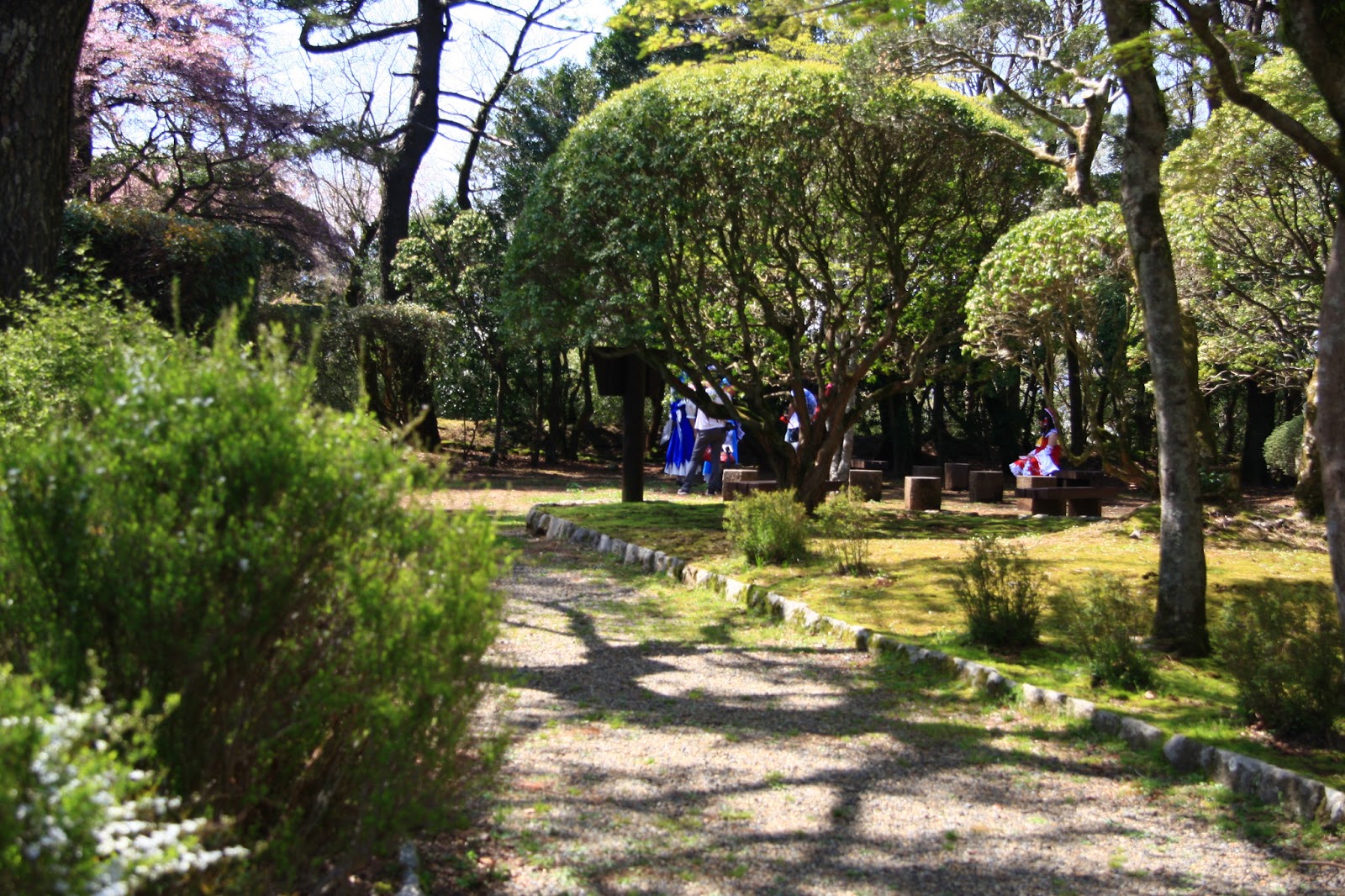
The path led away to some sparse forest, were the keen otaku eyes of Bryan and XM spotted a few cosplayers having a photoshoot between the trees. They didn't go up to talk to them, though, or even to take photos, but the ever-vigilant observer XM pointed out that they were cosplaying from the Touhou project.
 
Also taken from a hidden spot in the bushes, so this is an authentic photo.
On our way back we passed by the ninja museum, which we did not patronize because of funding issues. There were a bunch of brightly-dressed ninjas outside, though, and I remember thinking that they were quite hilarious because no ninja would dress up in a bright pink outfit. It was like a mix of Power Rangers and Disneyland, because they were very obviously a tourist attraction.

There are no fewer five real ninjas in this photo. Can you spot them all?
A return to our ryokan early for dinner prompted a short expedition to the town of Gora, at the base of the mountain; except that when we went to dump our bags we left our rail pass in the room, which made taking the cable car out of the question. We decided to take a walk, down the sloped incline, and I caught a sakura petal in my hand.

Dinner was another sumptuous spread of classic Japanese cuisine. A plate of small appetizers, tempura, sashimi, tofu, and a huge crab hotpot with glass noodles.

Five seconds before it was all promptly devoured.
We spent the night watching Japanese television again, and had a lot of fun commenting on their variety shows, because that was mostly what was showing. I remember that one of them had this game where they tested the blowing power (I am not joking) of the celebrity guests. They lined up fifty lit candles in a row, and the guest had to stand at one end and blow as hard as they could, and the number of candles you extinguished with your breath would be your score, and you'd compete with the other guests and stuff. It was pretty hilarious.
Also, this girl was bloody annoying.

Before we turned in for the night, I managed to persuade the gang to take the Suntory Boss photo in our yukatas. It went a lot better than expected.

BECAUSE SUNTORY BOSS IS THE BOSS OF THEM ALL

*All photos in this post courtesy of Bryan.

Friday, April 27, 2012

The Japan Trip - Day 13

Delicious onigiri was had for breakfast that day. As I was hobbling with XM to the konbini, I was worried that my damaged leg wouldn't be compatible for the hike - it hurt slightly, but I decided that I could manage it.

It was a very scenic hobble, though.

After we packed up and left, carrying our huge backpacks, we caught a train to the start of our hiking destination, Odawara Station.

*giggle* *giggle* romance car *giggle* *giggle*
The hike was XM's idea - he really wanted to do something crazy in a foreign country, and short of starting a religious war, this was the next best thing. It was originally supposed to be twenty kilometres across the southeastern part of Japan, following the coastline with Mt Fuji on our left, but when he went to check out the route on Google Maps, it was along highways without any pavements. He was all for it though, but the rest of us were worried that it'd be dangerous and illegal, and as gaijin didn't want to spend weeks being interrogated in a foreign language. So it was cut to a short 8km hike between a couple of stations along the train line we would have taken anyway, across pavements and through the more suburban areas of Odawara through to Hakone. Bryan ambitiously took a Google Maps photograph every ten steps. It actually turned out pretty well, all things considered.

There was a slight drizzle in the morning, but that was all just water under the bridge.
Walking in tunnels always gives me that nice, warm, being-evacuated-due-to-a-zombie-outbreak kinda feeling.

Smatterings of suburbia.
We stopped for lunch at a quaint soba restaurant, where I had cold soba because it was so hot. Actually, it had drizzled earlier in the day, and the air was cool but humid, and trekking with a backpack with no space to store your sweaters meant that I was losing more water weight than what I could carry in my small 500ml thermos (which tasted of metal anyway). We were probably the youngest people there paying for their own bill. It was there that I learned that authentic soba restaurants will serve you the water that your soba was cooked in, at the end of your meal, still warm, and you're supposed to pour it into the soba sauce and drink it all. There were also a number of Chinese businesspeople sitting on the next table, and you could tell that they did not learn about native traditions, because they were putting their noodles into their spoons instead of slurping them. Their Japanese colleague or host was slurping heartily.

Soba water not pictured.


The walk was mostly uneventful, but surprisingly quick. We got about 60 percent of the way in the first hour. It seems that walking is a lot faster when you are walking through nice scenery and don't have to do it in time while singing a lot of stupid songs which are supposed to take your mind off it and build cameraderie but actually just tire you out more. We travelled through a lot of suburban neighbourhoods, and by train tracks, and past a lot of interesting flora, and another young backpacking couple going the other way.

Young backpacking couple who waved back at us not pictured.
Contrary to whatever I looked and sounded like at the end, I thoroughly enjoyed the walk. The view was, of course, beautiful, but that doesn't do justice to the entire experience. Seeing it in pictures is not enough; you have to actually walk through it to feel it. I loved the suburban feeling of the whole route; you have glorious countryside all around you but you don't get that isolated feeling because there are buildings and cars and people. I loved it a lot.

And trains. Quiet trains which trundle by without the freaky smiling faces on the front.
This is the kind of neighbourhood I would love to have grown up in.
(Because it's in Japan, is what I'm saying.)
I really wanted to know what carps have to do with earthquakes.

Canals are just so much more beautiful in Japan.

Eventually we reached Hakone Station, and took the train to Gora Station, at the foot of the mountain we were staying on, and then took the cable car up the mountain to Nakagora, somewhere about midway.

Oh, and Achievement Unlocked: Hike 8 km in a foreign country.
This was the first slanted cable car I had ever taken.

Our Hakone accommodation was a ryokan, a type of traditional Japanese inn, where you sleep in futons and yukatas, can take a dip in the onsen, and eat delicious multi-course dinners. On our way up, the cool mountain air was able to accommodate some of the sakura late bloomers, and the fallen petals covered the road like snow.

This is going to be the cover of our upcoming album.
It's so much easier to fall in love with nature when it's not trying to be muddy at you.

The ryokan. Like, snow, literally.

Obligatory artistic shot.
We tried to check in with the friendly lady at the counter, but failed, so she brought out her husband from the kitchen, who could speak more English, and were shown our room. We were served an introductory dessert, sort of like mochi with sweet honey and peanut dust.

The peanut dust could, you know, hypothetically, make one choke, if one accidentally inhales it like an idiot. Hypothetically speaking, of course.

The interlude to dinner was spent watching hilarious Japanese commercials again. It's very ironic that we were flipping channels trying to hunt down the ads instead of avoiding them.

How else would you enjoy this wonderfully luxurious room?
Dinner was held in the main dining hall with a few of the other guests, but at individual tables. I already had an impression of ryokan dinners from Japan hour, but the spread we were served just blew it all away. The 20k yen we were spending each night seemed totally worth it. There was sukiyaki, the main dish; with tempura and wasabi fish porridge and sashimi and a cold platter of assorted unidentifiable things and miso soup and vanilla ice cream with strawberry sauce. And that was only the things I could remember.

My taste buds thought they had died and gone to heaven.

We were determined to try the onsen - hot spring - that night, so we got all our bath stuff and waited. It was a communal bath, so each "group" can only go in for an hour or so, and you have to put up the "occupied" sign outside the door. After the quick shower to get clean, I tried dipping my legs into the water. And here's the thing: all my life, I expected hot springs to be mildly warm, like 40 or 50 degrees Celsius, so it would be relaxing like a warm shower. This one was insanely hot, probably around 70 or 80 degrees, hot enough to boil eggs. The feeling, when you leave your legs in for a while, is that it is so hot that it feels biting cold, like all your nerve endings are just committing suicide from he heat. Bryan said the trick was to immerse yourself into it slowly, bit by bit, so I was sitting there broiling my feet for a couple minutes. Another thing: ripples and water currents make it exponentially worse, so when XM was done with his bath and stuck his legs in, the water movement scraped across my roasted nerve endings and made them commit suicide again. In the end, though, I managed to immerse my whole body - up to my neck - into the natural cooking pot. For about five minutes. Then I couldn't take it, and climbed out.

Two things I learned: Bryan said that the intense heat could swell the blood vessels and make you feel light-headed, and that his friend had fainted when they had tried it the week before he met us. I think that would be the natural response to being cooked alive. The second thing I learned: the convenient steam censorship you see in anime has very strong basis, but it doesn't work well enough in real life. After the scalding, I drank a can of cold coffee, just like how I was taught in To Aru no Majutsu no Index.

Oh, and Achievement Unlocked: Cook yourself.

Thursday, April 26, 2012

The Japan Trip - Day 12

I woke up really early today, which might have been because my futon faced the window and the sunlight was barging in through the curtains. I saw that it was 6 am, and also saw that it was raining, so I thought, I'll go back to sleep.

Today was a travel day, so we didn't have anything on "the agenda". We were chilling in the hostel for most of the morning after breakfast. I had somehow developed a stinging pain in my leg, which hurt when I walked, and wasn't very heartening since we had a long hike the next day. So I took whatever painkillers I dared, said goodbye to Maru-san and Yuu-san, and hobbled our way to the train station, keenly trying not to miss our train and arriving half an hour early anyway.

Sayonara Sou-san!

We took a train to Maibara then through Nagoya to Shizuoka. Lunch was a quick delightful affair of a bento box hastily consumed along the train ride. I had started listening to LiSA's latest album in preparation for her concert, and fell asleep midway.

Sounds like a dish.

Our hostel in Shizuoka was another small place called Momotaro Guest House. It was larger than Pongyi, and it took up five floors of apartment flooring rather than a small side house on the knife-edge of the street. The office on the second floor was empty when we visited, but the lady came eventually, but she didn't speak much English. We fumbled our way through the instructions, and wound up on the fourth floor, being shown our rooms.

I like to believe that we stayed in a wide spectrum of lodging for this entire trip, and Momotaru Guest House provided most of one end of that spectrum. You couldn't really call them rooms - cubicles were more appropriate. The management used some false boards to partition out a couple small living spaces, with just enough space for a bunk bed, a small staircase/bedside table, a writing desk with a small stool and a television on a shelf, all in the space of an average closet. Don't get me wrong - I was not complaining, it was quite clean and certainly more comfortable than, say, a bunk on Tekong. It was just really small and narrow, and you start to understand that this wasn't a place to stay, just a place to sleep in. I bunked with JX, and there was just enough space to squeeze our two relatively huge backpacks into a corner.

Still better than army.
It was too early for dinner but too late to go sightseeing, and Shizuoka wasn't much of a tourist destination anyway, and my leg wasn't built for anything but lounging around in front of the television. So that's what we did. There was a French guy there using his laptop, but I'm sure we disturbed him enough to send him back to his room for more privacy. That was because we started watching the large communal television, and commenting on everything.


Those two hours were the basis for most of our inside jokes for the next two weeks. We mainly watched the Japanese music channels, one part trying to see what nice music could be found, and one part laughing at all the hilarious music videos in a language we couldn't understand. There was Mister Constipation, and the Funny Hand Signs guy, and a bunch of nice music and the Humping Girls.


We were inspecting the map to the city, pinned on the wall next to the television, deciding where to go for dinner, and were met by this half-South African, half-Japanese guy, who we chatted to, a bit, and it became obvious that he was one of those very liberal type guys, who could introduce us to his favourite oppai bar. But he also could introduce us to one of his favourite under-18 eating places, and we took his suggestion and trekked out into the persistent spring shower to hunt it down.

The best in wireless GPS.
It was a nice restaurant, where I had a nice tonkatsu donburi. Bryan kept commenting about Japanese people, sometimes not in a very positive way, and when we kept discouraging him, he just said, "It's not like anyone could understand me." So when we left, I said, "I bet all the other people in there are like, 'I say, those foreigners were bloody rude, if I do say so myself,'" in that posh British accent. Recurring joke number two for the day.

"My word, I cannot for the life of me believe such impertinent behaviour!"

On our way back that night we passed a Starbucks, and was tempted to try some of the local flavours and talk to the cute girl behind the counter.

It was soooooo good. The coffee, I mean.

Most of the rest of the night was spent watching more music videos, showering in the female shower because there weren't any of them on our floor and it was cleaner, and squeezing into the cubicle for sleep.

*All pictures in this post courtest of Bryan.

Wednesday, April 25, 2012

The Japan Trip - Day 11

This morning I went to get breakfast from the nearby konbini and I got stuck at a pedestrian crossing because of my colourblindness. Everyone says it's one of the smallest disabilities and it doesn't really affect your life unless you're a pilot or a part of a bomb defusal squad, but I want to point out that it can affect you in very real and dilapidating ways. So I was standing there at the crossing, and there are cars going by, it being rush hour and all, and I can't cross the road because the signal is still red. So I'm waiting there for about five minutes and the lights haven't changed, so I look around for the button to push (push until shiok) and I notice a button, but I can't tell if it's red or green and the label doesn't help because it's in Japanese, and there are no other visual instructions or anything, except Braille. I'm thinking, this is probably the button to press to change the lights, but I can't tell for sure and I don't know what Japan crossings are like, and if it was actually red I might be pressing some, I don't know, emergency stop system, or something. So I wait for another five minutes and it soon becomes apparent that these are the traffic lights which won't change until someone presses the button. So I pressed it, and in a few seconds the amber lights come on and I'm crossing the road to my breakfast. I was stuck at a traffic junction for an indecent amount of time because of my deuteranopia.


Curse you colour-coded forms of communication!
Our explorations for that day took us to the samurai district where the homes of the old foot soldiers stood. It would probably have been a more informative excursion if we had someone who could read Japanese. The only signs that we could read were the ones pointing out the different rooms in the traditional household. They weren't very big, a couple of small rooms with a second storey storeroom, but the gardens were about half the size of the house. There was one big complex with a very ornate garden, and had some sakura left to make the whole scene really beautiful.

Join the army, get a tree.
We visited Kanazawa Castle and just our luck, there was a free tour guide there and she spoke English, so we got explanations about the compound, which was pretty bare except for a few buildings here and there, mostly gardens and the large wall which surrounded the complex. She brought us to the nearby Kenroku-en, or "Six Attributes Garden", which was named for being designed according to three pairs of opposing landscaping attributes, like "water" and "open spaces" and some other things which I can't remember. It was quite a warm day, and there were a few flowers in bloom. The guide also introduced us to a variety of sakura native to the Kanazawa region, which she said only bloomed for a short time each year, and that we were lucky to see it while we were there.

Lucky flowers!


We visited a nearby shrine, and it had a small pond, with tiny fish fry and a couple of pond skaters. I bought a fortune there for just 20 yen. I don't understand this form of fortune-telling; the fortunes are all in a plate or box next to the sign for donations (or prices), and sometimes they're even numbered, so if you know #42 was the one with excellent luck all year you'd pick that one, right? Even if they weren't numbered, it's not very mysterious to just pick a lottery of fortunes - and it's a bit ironic too.

There's a story behind the lantern but I can't remember what it is.
Lunch was at a place called Matsumoto, this restaurant with a huge garden and a stone arch over the entryway. It looked pretty formal, and we were a bunch of young tourists in our jeans and sweaters, and the waitress was in a kimono and the only other patrons we could see was a businessman at the counter and a couple of office workers. We got shunted to the back, as per Bryan's theory of the Japanese Restaurant's Policy towards Foreigners, and we only chose food from the menu that we could read, or if the kanji was pretty obvious, like "meat". I had a good tempura udon, while XM and Bryan had these huge multi-course meals.

There's no al fresco dining though.
A walk was taken through the historic geisha district. It was small and narrow with many tiny souvenir shops, and there was a very strong sense of wooden architecture around the whole area. There was a very attractive aroma coming from one of the pastry shops, which drew my nose towards it, but my pocket protested once it saw the prices. At that point, we still needed to save some money for Tokyo.

There's a minotaur down the right-hand path.
Our wanderings brought us past this gold leaf shop, where they manufactured gold leaf by pounding gold until it got flatter and flatter and it was only a few microns thick. I never knew that's how it's made; I always thought they squeeze it through hot rollers or something. Instead they have this large pounding machine, which basically just pounds a few times per second, and they put the squares of gold leaf under it and pound it and then they cut it and pound it again.

You too can make your own gold leaf, for only 24 easy payments of $49.95!
There were samples of the thinnest... samples there, and it was almost translucent. There was also a gold-plated replica of one of the rooms of the Imperial Palace, I think it was, and everything in it, from the walls to the floor and even the teacups, were all golden. There was also a golden replica of a five storey pagoda.

It's actually a pretty accurate logarithmic scale in descending order.
It takes two hundred thousand dollars to live in this room... for twelve seconds.
Goldfinger!
We were all a bit awkward in the shop, because the sales assistants treated us like potential customers all the way, which was not all bad but they expected us to be rich paying customers, so it was the first-class service, the type where they stand by you while you watch the video of how gold leaf is made, and serve you green tea cake with a gold leaf finish, and tea with a sprinkle of gold flakes in. It was probably the most expensive-looking meal I had the entire trip. I say "expensive-looking" but it was probably only worth a few cents, since gold is sold by weight, and a few hundred molecules of it probably isn't worth much. But since we didn't want to eat their gold cake and drink their gold tea and just leave, we made some small gold plated purchases. I bought a small sticker for about 300 yen. There was also a lady proffering us tiny, millimetre-square samples of gold leaf, and she asked us to rub it into the palm of our hands, and we did so, and they dissolved. Completely. No smell too. That's how little gold there actually was. I probably still have a few atoms stuck to my skin now.

Mmm... money...

Would you buy a gold facial mask?

Or gold-plated golf balls?
We arrived back at the hostel early, and everyone else wanted to hang around because they were tired. The staff announced that they were having a gyoza party that night, and requested our help to make the 300 dumplings. XM went to help buy stuff from a nearby supermarket; I however, went for a walk, past the nearby konbini with the horrible button, down towards the post office which didn't look very tourist-friendly, and down into the residential area, just looking at people and houses and birds and the electrical system and bicycles and cars and the whole feel of a Japanese neighbourhood. I made a discovery as I passed the wide waterways: a large wheel and chain system, with hooks on a conveyor belt, continuously clearing away the leaves and debris from the grating.


When I got back at around 6 pm XM told me that the stuffing was still being prepared, so we hung around outside the guest house, chatting and watching the flowing water and finding out that the barrier gate is not locked.

Inside the small cramped living/dining room, waiting for us, was a large bowl of strong-smelling raw meat and vegetable mix, the stuffing of the gyoza which would inevitably be stuffing our stomachs. Yuu-san taught us how to fold a small lump of raw stuffing into the small circle of dough, and it was obvious from the beginning that I had no natural talent whatsoever. It was fun, though, chatting as the repetive task become third nature, like second nature except not so. Midway through this extravaganza, we were introduced to the guest who would be sleeping in that room that night, because of space issues. His name was Vinh, he said he was Cantonese but from Canada, and he was studying in Japan for a while before returning to Canada. I had a feeling he had Vietnamese blood though, because his name didn't sound very ethnic Chinese.

I made that plate!

Soon all the hundreds of gyoza were wrapped up in their individual packages, and sent to the kitchen for Yuu-san to fry. The sizzling smell of adequately-burnt dumpings was intoxicating. The dining tables were set up, and soon we were sitting down to dinner with Vinh, a Japanese man called Sou-san, a lady from Thailand on a short holiday before her conference called Patti, and the two staff, with promise of Masaki-owner-san joining us later.

It was mostly talking about our countries again, how everyone is amazed by Xi Min's level of Japanese, and Sou-san gave us an introduction to the intricacies of the Japanese language, about how there are four variations for "cool down" and a different phrase if the door was opened by a person or by itself. We pointed out how most kanji was similar to Chinese characters, and there was mention of JX's Japanese name as well. Vinh said he had long ago compiled a catalogue of the different meanings of kanji in both Chinese and Japanese. Eventually Yuu-san, who I was sitting next to, was asking me to translate stuff for her, or at least correct her broken English, for phrases that she would need to use around work.

From left: Yuu-san, Sou-san, Vinh, and Patti. Picture courtesy of Vinh.


I don't normally like gyoza, but these ones were delicious, and with the saucy mix of vinegar and soy sauce made it excellent. I think the talk seasoned it as well.

Our room, complete with futons and strewn baggage.
 *All pictures in this post courtesy of Bryan.

Tuesday, April 24, 2012

The Japan Trip - Day 10

I woke up early this morning to go for a walk. I had not really gone anywhere my myself up till now, and I just felt like walking around by myself, like JX presumably does. As I might have mentioned earlier, our hostel was located near one of the major shopping streets, but we've always been walking down the right, so I decided to walk down towards the left. Munching my morning breakfast of a bun I cannot remember, I soon came to regret my decision. Nothing much was open so early in the morning, and that half of the street was mostly banks and offices, so nothing much to do or see. I kept munching.

Offices to the left of me; shops to the right; here I am, stuck in the hostel with you...

Our feet first brought us to the Kyoto Manga Museum. When we entered we found out that there was a special exhibition going on that day, so we bought the ticket. The first floor was a large manga library, full of not just manga but other comics from around the world, a few translated to English but most translated to Japanese. I didn't recognise most of the English translations because most of them were the mainstream famous ones, and when I did spot the superhero comics they were all Japanese translations.

I thought it'd have a huge manga drawing on its facade. Oh well.
Though I did encounter something else which was very intriguing: it was a program designed to make manga easily. And it's not just some Comic Book Creator thing - you can choose to make characters and there's a 3D template and you can customise them and you can rotate them and they have different poses and you can basically make a whole strip without having a pencil touch the paper at all. It is quite scary to what extent technology can emulate art, which imitates life, which imitates each other.

The main exhibit was a historical timeline of manga in Japan, all the way from its roots as political cartoons to the storytelling devices they are today. Scattered among the hallowed shelves were large posterboards educating the uninformed about the painful life of mangaka, or manga artists, and other information about the history of manga. I was particularly amused by the large volumes locked high above the shelves out of reach, the really rare copies which could only be accessed by researchers.

The special exhibit was more of an art exhibition, with over a hundred masterpieces done by eshi, which are the artists who don't really draw for a manga but also things like games or light novels. The theme was "Japan", and most of the artists drew a bishojo, or beautiful girl, as their focus. Not that I'm complaining. Most of the art was exquisite, masterpieces of style, technique and beauty. I can't stop wishing that I could draw like that. They were so good I wanted to bring them back with me, and I did, by buying the artbook compilation.

As we wandered around the other exhibits, we noticed a room dedicated to the original tenants of the building: an elementary school - which explained the wide staircases and classroom-like layout. That was pretty interesting. There were also other exhibits, like the plaster cast replicas of famous mangaka who had visited the museum, an area dedicated to women's fashion inspired by manga, and also one dedicated to art produced in response to the Fukushima tsunami and earthquake of yesteryear.

We had lunch at a Sukiya across the street. It was pretty decent - good, not excellent, but for its price was very worth it. For those not in the know, Sukiya's like Yoshinoya (which is also there), like a fast-food place but without the American influence, so there's a lot of rice bowls and similar easy-to-eat foods.

We also saw this adorable couple.

We walked back to the main shopping street opposite the temple to try and find Bryan's Green T shop, which supposedly sold novelty T-shirts. There was much wandering around the small shopping buildings with its twisty corridors and unintelligilbe signs. We eventually found out that we had passed it on our way in, and we had done so without noticing because it was closed for the day.

It was another unevenful train ride to Kanazawa. Xi Min had told us that Kanazawa was a small country town, so we were expecting something like Tottori, and as the train passed through nothing but farms and wide open fields, we expected something even smaller than Tottori, maybe not so much a town as it was a village, or hamlet.

...the middle of nowhere, with her husband, Eustace Badd!
When we got to Kanazawa it was actually quite a town-sized town, not as big as Kyoto, but certainly not as small as Tottori. There were a few tall buildings around the train station, but the streets were not crowded like what you would expect during rush hour (which is when we arrived). The effect was a very quiet community, not bustling like Kyoto had been (and not a fraction of what Tokyo would be), but not small enough that people will call your name in the street. It was also drizzling slightly, so it was quite cold.

It's practically bustling.
Our Kanazawa hostel was a small guest house called Pongyi, about ten minutes walk from Kanazawa station. And when I say small, I mean small. It looked like it was tacked on to the side of the row of houses along that street, and shaped so that it could fit into the curve of the road. The path to the entrance bridged a canal, which looks so much prettier than its Singaporean counterpart for the simple fact that the walls are nicely patterened with stonework, instead of the boring cement and concrete that we have. The inside narrow and, with our huge backpacks, cramped, and also fragile, because of all the paper walls.

But it's a very nice place.
That said, the staff were extremely friendly, and the one who greeted us at the door was called Maru-san, a small lady who put me in mind of a mouse. She introduced us to the hostel protocols and showed us around. She also showed us how to set up the futon, which is the traditional bedding of the Japanese people, after the tatami mat. We were also introduced to the owner of the little hostel, Masaki-san, whose name I couldn't remember and resorted to calling him owner-san. Owner-san directed us to a good curry place for dinner, and it was absolutely delicious. I cannot stop espousing the ideal of Japanese curry, and this one had cheese in it. Simply fabulous. It also had free soup, which was seaweed and tofu and mostly pepper.

My mouth was in heaven.
When we got back to the hostel we were introduced to the other staff, Yuu-san, who looked like a younger lady but about mid-thirties. We also stuck around in the tiny common area to chat with some of the other guests: two British girls from London, Natalie and Alex; the happy-go-lucky Swiss traveller Philip, the German couple Stefan and Diana (I think); the French couple with the accents Bryan loved; and the crazy Australian guy whose name I didn't catch.

We chatted with Philip and the British girls mostly, since the others weren't seated down and were mostly going about their daily chores like bathing and nighttime snacks and stuff. Philip was insane - he was only there that day because he had drunk too much the previous night and was so hungover he missed his bus out of town, and so had to stay another day to catch a night bus. But he was very friendly and curious about our county.

A note about foreigners and Singapore. Most of the people we met on our travels were very interested in our little island nation, and most were also not very familiar with it, even though it's apparently one of the top Japanese travel destinations since it's so close to home. I think one of the first assumptions they make is that we're all Chinese here; I often explain how we're a multiracial society and because of that, English is a common language and official "working" language, even though our "national" language is Malay (which they also get very confused about). I think it's very nice to introduce other people to our country, acting as sort of informal ambassadors, and you get to learn so much about their country. The international-ness of the whole thing is so refreshing.

*All photos in this post are courtesy of Bryan.